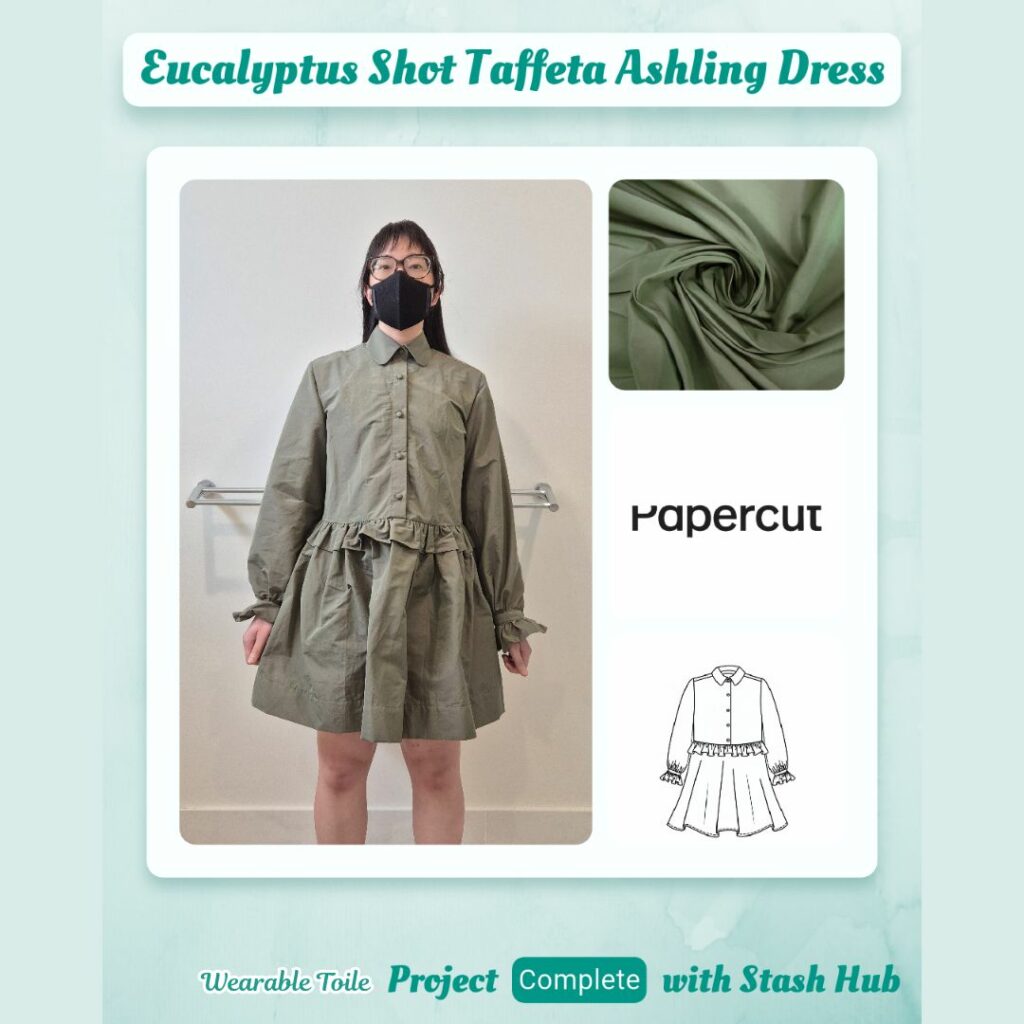
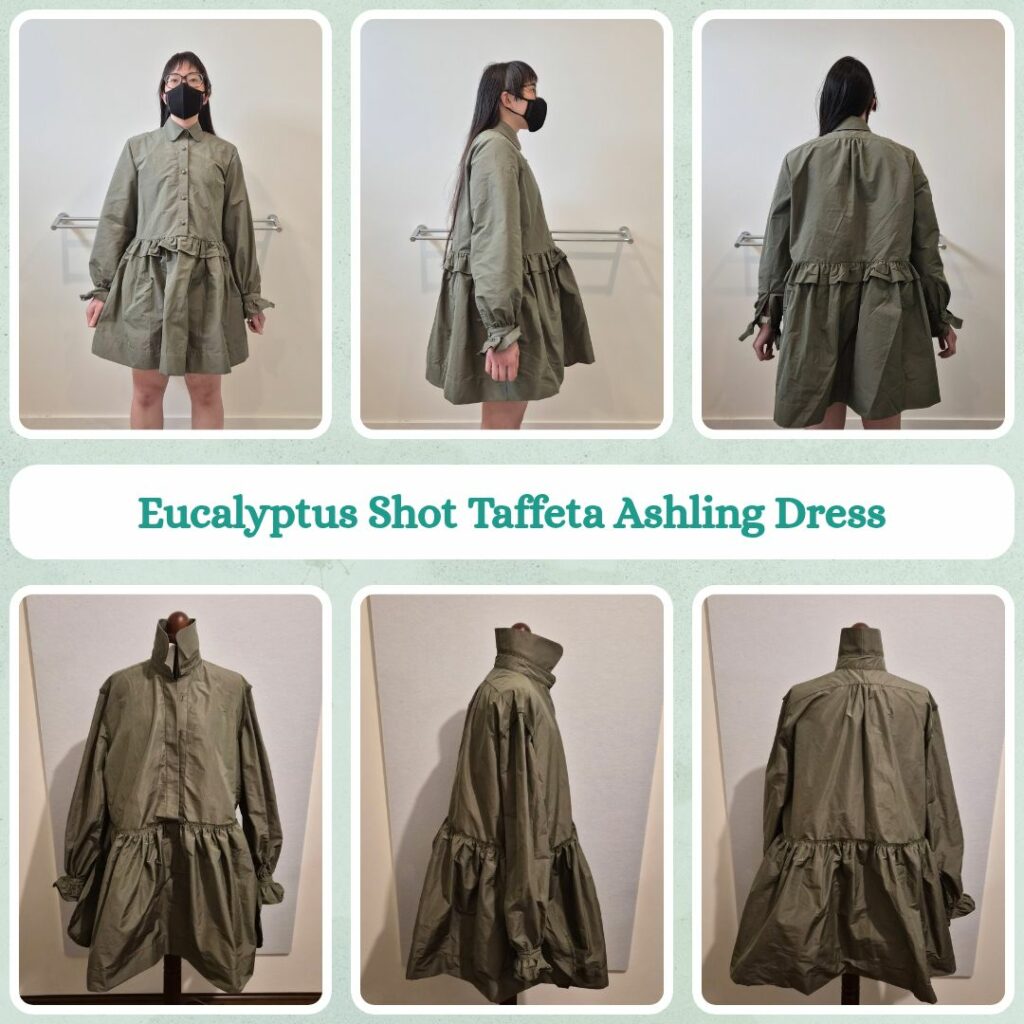
Planning and Design
This was actually one of the first patterns I bought when I got back into sewing. But the fabric I chose for it, I chose based on the fabric pattern and really it’s probably too light and floaty for this style, since the ruffles are a major draw. Early on though, I did buy the fabric to make a wearable toile, which I bought because it was taffeta and I was just really curious what it would be like to sew and wear taffeta (it’s the kind of fabric that I’m familiar with from reading books but no idea what it’s actually like).
Materials
- Pattern
- Ashling Dress (Papercut Patterns)
- Fabric
- Cotton Blend Shot Taffeta – Eucalyptus Green (Remnant Warehouse)
- Buttons
- 12mm self-cover buttons (Daiso)
- Thread
- Rasant col. 1626
- Notions
- Heat n Bond Fusible Interfacing – Light
- Steam-a-Seam 2
Sustainability Check
🤏 Fabric is 80% cotton, 20% polyester, but it is also deadstock
🤏 Rasant is OEKO-TEX but not biodegradable
🤏 Buttons are metal but are covered in the cotton/polyester blend fabric
👎 Fusible non-woven interfacing is 100% polyester
❓ Unsure on the composition of Steam-a-Seam
Construction
Prep Work
I tend to look at the hip measurement for initial sizing and so this time I was a size 4, for which the waist measurement matched well (bust will never match LOL). I was prepared to have to do a SBA but turns out there is no dart in this pattern. From the Tomigaya Dress, I know that I may need to shorten the bodice piece as the “SBA” but thought I would make it as is for starters. This is a wearable toile after all.
Given my woes attaching interfacing and having the pieces shrink, I decided to block fuse for the few pieces that needed interfacing. I used the non-woven interfacing I still haven’t managed to fully use up, since this is a polycotton blend. Also made sure to check I had all the pieces this time, after my brush with disaster on the Sage Softshell Caramel Jacket 🙃
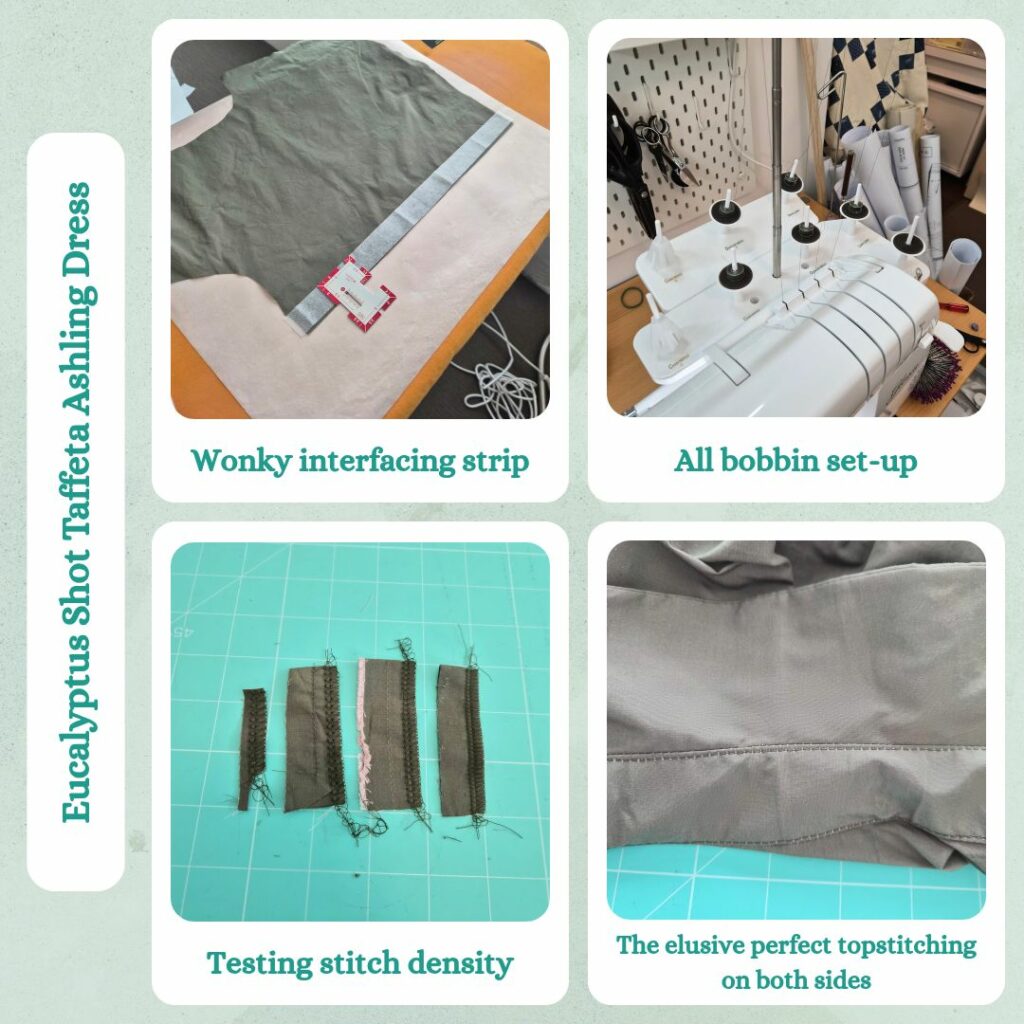
I gave a lot of thought to whether I should french seam/encase all seam allowances, but thought I would give the overlocker a go since I have realised overlocked edges can be pretty, as long as I use the right thread. Of course I came to the decision the night before starting the project, so didn’t have time to buy proper fancy thread. But again, wearable toile, figured I could test if Rasant meets the ‘fancy’ thread threshold. Bonus that the Gloria looks like it can take bobbins as thread spools (I wouldn’t have dared try this with my Janome MyLock haha). My overall thought is moving forward I probably won’t french seam dresses anymore? Especially if they involve gathers since that ends up being quite bulky. Funny how my priorities have changed from no visible seams to reducing bulk. Since I was curious though, I did a side by side comparison of the various thread options I have available to me. Next time I’ll do a proper overlock test as well, but for now just seeing the thickness of the threads was useful.
I recalled a member of Modern Makers mentioning they use the gathering foot on their overlocker, with the caveat that the gathers are sewn in place. I actually have a gathering foot that came as a bonus with the Gloria purchase. And wow, I didn’t realise the gathering foot gathered and sewed the gathered piece to the main piece at the same time! Game changer! or…it could be. But I read through the instructions (go me) and it seemed like it is limited to a 2:1 ratio, and I measured the pattern pieces and I don’t think the dress is designed with that ratio in mind (it’s less)… I did a couple of tests to see how this particular fabric responded:
- Gathering foot – 48cm long test strip -> 33cm (1:1.45)
- Normal foot – 23cm long test strip -> 17cm (1:1.35)
If I reduce the differential feed from two, it might be possible for me to get the right ratio for this pattern. So I decided I would assemble the relevant pieces and then measure to see what the ratio should be. Then if it’s not too much of a hassle, try to find the right differential feed setting to achieve this. Although I’m sure the ratio is going to be different for each gather lol…in which case I may just go with the normal foot because then at least I can release the gathers if need be. Another thing I decided was initially I was going to use the sage Maxi-lock thread I have on hand, but it doesn’t match the fabric enough so I will wind another 2 bobbins for this. I also was thinking about maybe sewing the seams on the Gloria too with the 5-thread safety stitch. In which case I will probably use the Maxi-lock for the chainstitch part because otherwise that’s a lot of bobbins haha.
I also looked up tutorials on how to do a narrow hem with ban rol. I think this is a technique I would like to try but I don’t think I have enough ban rol on hand for the length of the skirt hem haha. So I looked up a narrow hem foot and decided I would check if I had one, since this fabric isn’t super sheer the ban rol method may be overkill. And then I remembered that the hem is actually like 4cm wide and the other ruffles don’t require hemming LOL. But at least I can be prepared for future haha.
The other thing I looked up was how to bind a sleeve placket, because I’ve always been really terrible at this. I had a look at a couple of tutorials and funnily the order in which I looked at them ended up going more and more into detail. So I ended up deciding to follow this one.
And then finally (should have done this first lol), I looked up taffeta in the Minerva Fabric Guide and learnt that it should be treated like it has nap (luckily I did this anyway) and that importantly, pins can mark the fabric. So I will make sure to pin in the seam allowance. I also ironed from the wrong side and I used a pressing cloth so I think I’ll be ok there. There were also some tips on how to avoid puckering which is good to know in advance. As well as it doesn’t ease nicely, so will make sure to use the Gloria to gather the sleeve head slightly before attaching.
Even More Prep Work
In the quest for ultra efficiency, I mapped out the sewing/thread set up order, since I would need to transfer some threads from the Skyline to the Gloria for the 5 thread safety stitch (I could have wound yet another bobbin, but felt like it would be a waste as I anticipated I wouldn’t use up all the bobbin threads).
- Skyline sew front placket, yoke, sleeve binding and assemble frill pieces
- Skyline sew the buttonholes
- Gloria 4 thread overlock for gathering the frills (including skirt pieces – straighten out ends for sewing side seams later on)
- Gloria 4 thread overlock for gathering the sleeve head
- Gloria 5 thread safety stitch for sewing bodice, sleeve, skirt and pocket seams and attaching skirt to bodice
- Skyline to attach cuff ruffle and topstitch hem and cuff bands and add cuff buttonholes
Before sewing though I covered the buttons and tested the buttonhole size so I would be prepared for the plan above. Although I forgot I used a bobbin to gather the button covers and then forgot it was on my work table so ended up winding another spare bobbin lol. I can still test out my sewing order though I guess.
I tested out a bunch of stitch width/length configurations for the 4 thread overlock to see what looked best with the Rasant. I think 5.5/2.0 (width/length) looks the nicest, probably because the Rasant isn’t as thick as the Tutti I’ve previously used, so spacing the stitches out makes it look very spidery.
Sewing
Before sewing I wanted to overlock some denim so I could pre-wash it and decided to just use the Rasant since that was set up. And it was good to learn that a bobbin is roughly 3m of stitching at stitch length 4 and width 5.5
I used what was left of the bobbin to gather the back for the yoke, however the differential feed of 2 didn’t gather it enough so used the tails to make it tighter. I attached the yoke using the burrito method and graded seams like a good girl lol.
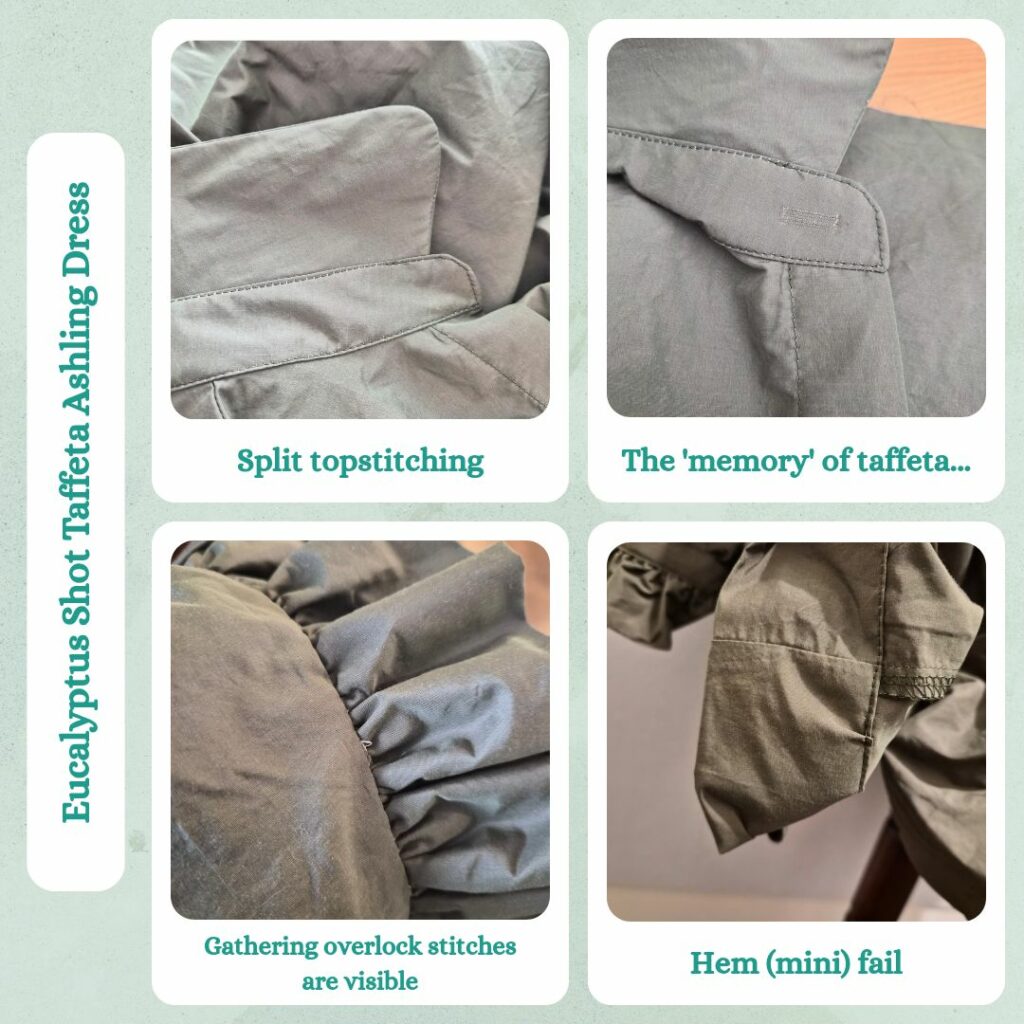
The next part I tackled was the collar, which was hard to ease into the neckline but conversely easy to turn out collar band curve due to the dense weave. I was impressed at how close the topstitching was on the collar band from the wrong side, it looks like the perfect offset. I guess that means I need to continue with 1cm guide-stitching. I also split the topstitching so that the rest of the collar band was topstitched from the front. I care about this kinda stuff too much…
Then I did the buttonholes on the front placket and stuffed up the collar buttonhole by starting at wrong marking…which meant that after I unpicked you could see the needle marks 😣 So I made the automatic buttonhole 2 clicks larger to make a longer buttonhole to cover up the original needle marks.
Next was the sleeve slit, which probably needs to be shortened slightly if using guide stitching method. The hump jumper was vital in helping me sew the 45 degree seam after the sleeve slit was bound.
I used the Gloria to attach the sleeve head to the body and realised it’s better to do these sorts of seams on the Skyline because I usually have to unpick bits. I also sewed the side seam and the skirt pockets/side seam with the Glora safetystitch but in future it would probably be easier to just sew with the Skyline and overlock separately.
I attempted to use the Gloria to gather the frills which was an utter failure because the doubled fabric was too thick. So I used the Skyline single long basting stitch. I also switched to Tutti on the Gloria for the failed gather attempt because a single bobbin wouldn’t have enough thread to stitch the full frill/skirt length. Thanks to this I know that Tutti not a good overlocking thread for clothing because it’s not soft enough 🙁
After attaching the sleeve ruffles I used my ByAnnie’s stiletto to fudge the cuff band to not stick out too far past the gathering.
In order to gather the skirt I split into 4 sections, next time I will do 6 sections so the middle front/back are nicely gathered, which they weren’t this time since it was the section where the gather ends met. I should also backstitch at the beginning of the gather and snip away the thread tails because all the gathering threads started to get confusing haha.
The failed Tutti gathering stitches showed through because I wasn’t able to keep the gathered portions consistently at 1cm seam allowance, so unpicked all the overlocking (during a trip to Bunbury and back haha…) and re-overlocked, essentially getting rid of all the Tutti and replacing with Rasant.
Then I tried on the dress for hemming and in order for the hem to be above the knee and I needed to turn up 12 cm. Because I’m lazy, I made this into a 6cm double fold hem but will do another version of dress with a shorter bodice (so frills sit at natural waist) and then adjust the skirt length accordingly (I think a 4cm double hem or whatever the original design says would be good). I used the Steam-a-Seam but didn’t set it with the iron, so the hem shifted slightly since it was so long, so there is a slight overlap at the beginning point but no one is going to notice because the skirt is so full lol. I also think the sleeves could be slightly shorter so the sleeve doesn’t bunch when the cuff buttons are done up and so the cuff will end up sitting at my wrist.
Then before I could put the finishing touches on (attaching buttons) I needed to add the cuff buttonholes, and realised I need to be careful sewing the buttonhole onto the cuff band as the ruffles can interfere with the automatic buttonhole.
Reflections
Not mentioned in detail in this post is the thread juggling because I decided to use bobbins for the looper. I will never do this again LOL.
In the end I don’t really need a sewing order since I can just leave the Gloria on a 4-thread overlock and just overlock the seams I need to and change the differential feed when I need to gather the sleeve head.
As expected the bodice is a bit long, and after hemming the skirt so much I think the dress doesn’t look quite proportionate. By shortening the bodice the balance should look better. The sleeves could probably also be shortened a tad.
I really like the collar on this. And I enjoyed wearing it although the frills in the sleeve did need some management haha. Best not to wear this on occasions that requires reaching over things that the frills could interact with (in this case high tea with jam and cream on the table).
Things I learnt:
- Gloria gathering foot doesn’t work well on taffeta or double + layers of fabric
- Closet Core method for gathering is still the best approach if needing to gather in the round
- Taffeta shows needle marks so need to be careful with pin placement and stitching
- Tutti doesn’t make for a good garment looper overlocking thread
- Wovens should probably be seamed with the Skyline instead of the Gloria due to the high likelihood of needing to fix up parts of the seam stitching
I will retrace the pattern pieces to have 1.5cm allowances. Partially because it’s very hard to gather with only 1cm allowance and also because 1.5cm gives me the option to french seam if I want to. Because I think I actually do really like that sort of internal finish. I will also shorten the bodice by 5cm, but I think it will be ok to leave the skirt as is. I liked the length of this one but slightly longer will probably be fine as well. For the sleeves I’ll shorten it 1.5cm, so just a tad. I’m quite looking forward to sewing this again 😊
Categories: Sewing

Leave a Reply